
What Children Actually Absorb From Screen Time (And What You Can Do About It)

The Invisible Curriculum Your Children Watch Every Day
Every parent knows the basics: limit screen time, choose age-appropriate content, maybe preview what they watch. But there's a layer most parents never think about — and it's the one that matters most.
The children's media industry doesn't just entertain your children. It teaches them. Every show, every app, every 30-second clip on a tablet is running a curriculum. The question isn't whether your children are learning from screens. They are. The question is what they're learning.
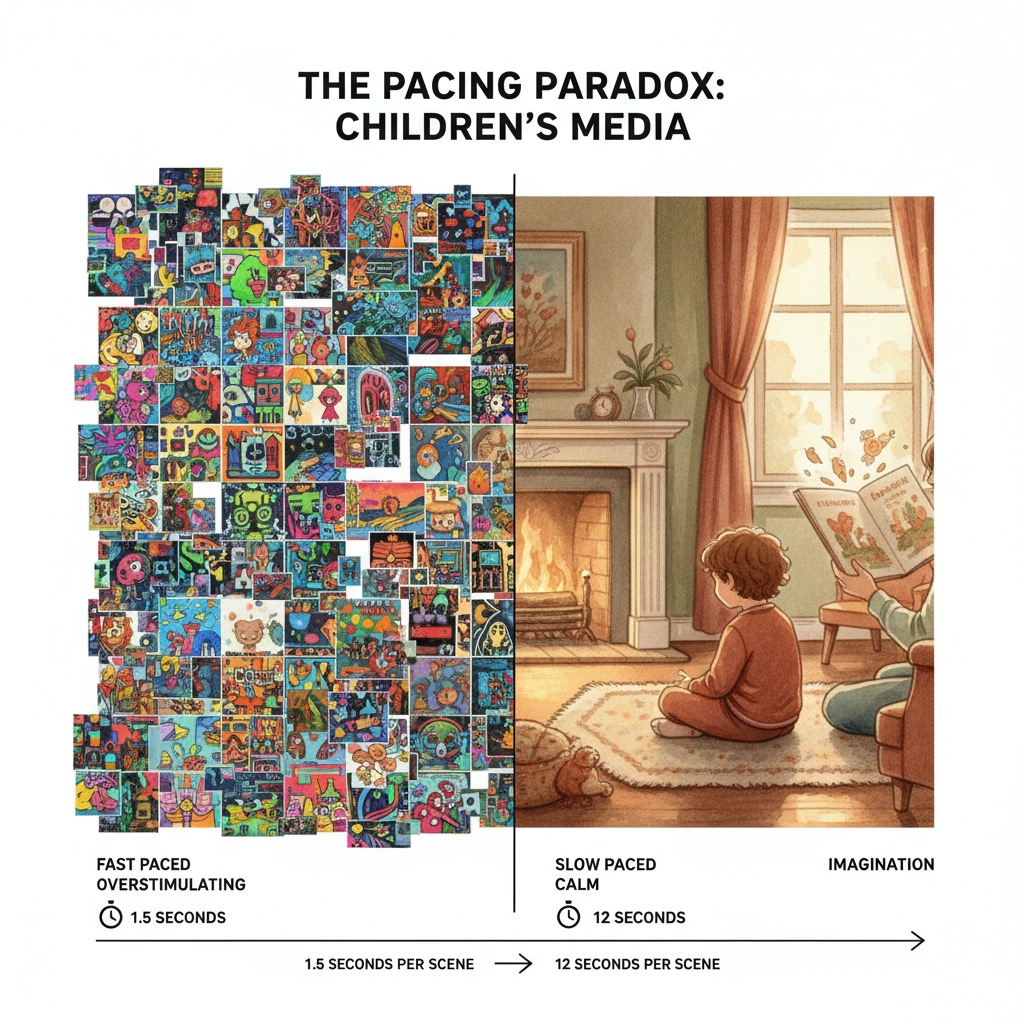
The show on the left changes scenes every 1.5 seconds. The one on the right holds a scene for twelve. One trains attention. The other trains addiction.
Rapid Cuts and the Attention Economy
The average children's YouTube video changes camera angles or scenes every 2-3 seconds. CoComelon — the most-watched children's channel in history — averages a cut every 1.5 seconds. This isn't accidental. It's engineered.
Here's why it matters: In 2011, researchers at the University of Virginia randomly assigned sixty four-year-olds to watch just 9 minutes of a fast-paced cartoon. Nine minutes. Afterward, those children performed significantly worse on tasks requiring focus, self-control, and planning compared to children who spent the same 9 minutes drawing with crayons.
Think about it. Nine minutes of the wrong content measurably impaired a child's ability to think clearly. And most children are consuming hours of this daily.
The mechanism is straightforward. Rapid scene changes create constant dopamine micro-hits — the brain learns to expect visual novelty every second. When the screen turns off and real life moves at its normal pace, the child's brain is bored. Not because the world is boring. Because their reward system has been recalibrated to need faster, louder, brighter stimulation to feel anything at all.
Parents describe the effect in their own words: "Like zombies, almost mesmerized." "My son turned into a monster." "It's toddler crack." They're not being dramatic. They're describing exactly what the neuroscience predicts.
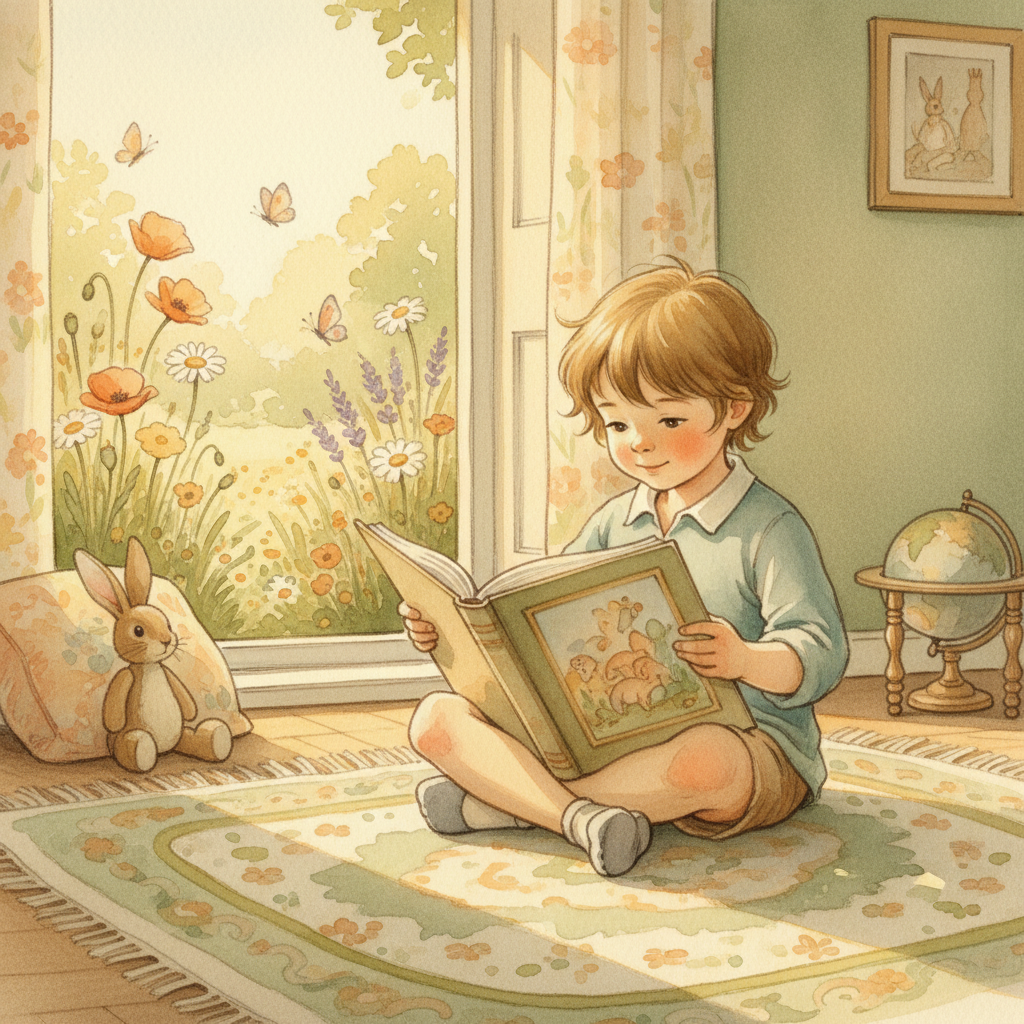
A child whose attention span hasn't been trained to need a new image every 1.5 seconds can do something remarkable — sit still, and be genuinely interested.
What's Actually Being Taught
Beyond pacing, there's content. Most popular children's shows operate on a simple values framework: be nice, share, say sorry. These aren't bad values. But they're shallow ones.
What happens when a child needs to stand alone? When the group is wrong? When being kind means telling someone something they don't want to hear?
Bottom line: the stories your children consume before age six are building their operating system. Not just their vocabulary or their knowledge of colors and numbers — their model of how the world works, what matters, and who they should try to become.
BST stories explore agency, natural law, discernment, and the relationship between what you put your attention on and what grows in your life. These aren't lessons that fit into a 7-minute episode with three musical numbers. They require space.
The Brain Before Six
Here's the thing: a child's brain before age six is doing something it will never do again. It's building the foundational architecture that everything else runs on.
Research published in longitudinal studies following children for over a decade found that screen exposure before age two — but not at ages three or four — predicted long-term changes in brain structure. Infants with more screen time showed premature specialization in brain networks involved in visual processing and cognitive control. The window matters. And once it closes, you're working with the wiring that was laid down.
Herbert Krugman's research at General Electric demonstrated that within thirty seconds of watching television, the brain shifts from beta waves — associated with active, analytical thinking — to alpha waves, a passive, uncritical state. Adults can switch back. Children, whose critical faculties are still developing, absorb information in this unfiltered state without the ability to evaluate what's coming in.
This is why what you plant in the garden matters more than how long the screen is on.

What grows in the garden depends entirely on what you plant. Most parents have no idea what seeds are already in the soil.
What Based Story Time Does Differently
I built Based Story Time because I couldn't find anything worth putting in front of the children I love.
Each episode runs 14 to 23 minutes with a deliberate visual pace. The art is hand-directed watercolor. The music is classical. The narration gives a child time to process, to imagine, to feel.
This isn't a production limitation. It's a production decision.
When a child watches a BST episode about Jaxon learning that his attention determines what he finds — not the other way around — they're not just hearing a story. They're practicing sustained attention. The medium is the message.
The lessons go deeper than "share your toys." Agency. Natural law. Cause and effect. How your vibration shapes what shows up in your life. Entrepreneurship. Health as a system you can understand and work with. Spirituality — the real kind, not the sanitized kind.
In my experience, children don't need to be tricked into paying attention. They need content worth paying attention to.
What You Can Do Right Now
You don't need to eliminate screens. You need to curate them with the same care you'd use choosing a school.
Watch the first 60 seconds of anything your child watches regularly. Count the cuts. Notice the pacing. If it feels frantic to you, imagine what it's doing to a brain that's still building its foundation.
Choose long-form over short-form. A 20-minute episode that tells a complete story teaches narrative thinking — cause and effect, patience, resolution. A 30-second clip teaches nothing except the desire for the next clip.
Talk about what they watched. Not a quiz. A conversation. "What did you think about what happened?" A child who can recall and discuss a story has actually processed it. A child who can't was just stimulated.
The garden of your child's mind will grow whatever you plant in it. The question is whether you're choosing the seeds — or letting an algorithm do it for you.
18 Years of Paying Attention
There are small, deliberate tricks woven into the entertainment your children consume. I have spent 18 years learning to spot them. The Garden is where I write about what I find — and what you can do about it. No schedule. Just an email when something new is published.